

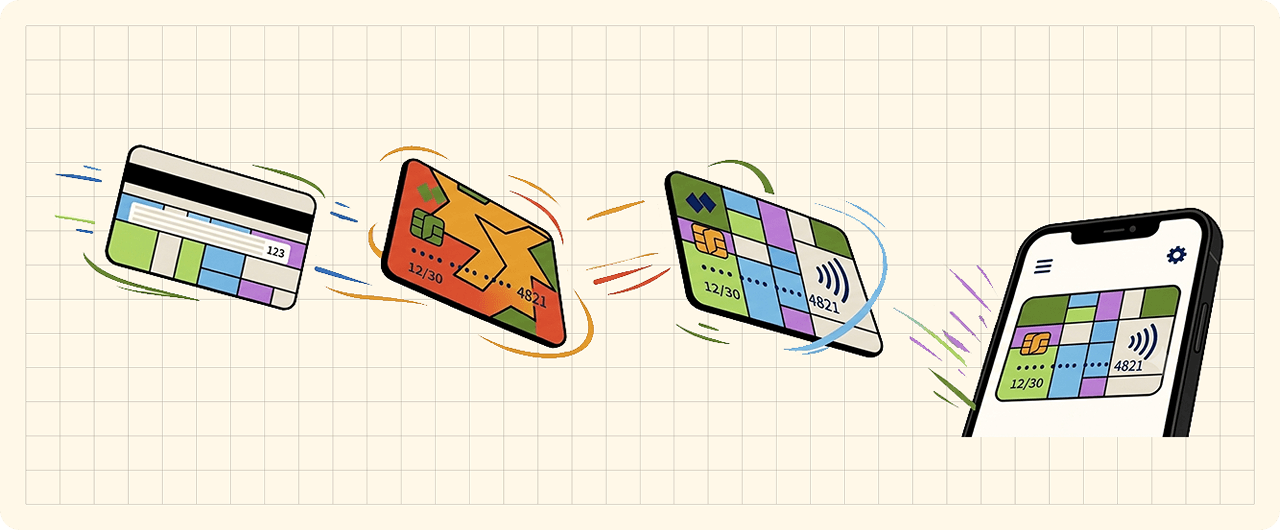
The Card is dead, long live the Card!
When mobile payments first emerged, the payment card appeared to be living on borrowed time. Smartphones would become the wallet, account-to-account payments would remove intermediaries, and consumers would no longer need plastic.
The smartphone has certainly changed how people pay. But it has not always changed the underlying payment instrument. In many markets, mobile payments have made cards less visible rather than less relevant. A card provisioned into Apple Pay, Google Pay or a merchant application remains a card transaction underneath the mobile experience.
The evidence is striking. In the United States, cards represented 79% of all non-cash payments by number in 2024, up from 71% in 2015. Card volumes reached 187.7 billion transactions, while credit-card payments grew from 51 billion in 2021 to 67.1 billion in 2024. Rather than being displaced by digital commerce, cards have participated in its growth.
In the Euro area, cards accounted for 45% of the value of point-of-sale payments and 48% of online transactions in 2024. Mobile-app usage was growing, but many wallet transactions continued to draw on card credentials.
Why have cards remained relevant?
Cards benefit from an acceptance network built over decades. The same instrument can be used in a local store, on an international website or while travelling abroad. Replicating that reach is difficult for payment systems developed primarily for domestic use.
Cards also do more than transfer money. Credit cards combine payments with access to credit, interest-free periods and rewards. Card networks support authorisation holds, refunds, disputes and chargebacks—capabilities that remain valuable in travel, hospitality, car rental and e-commerce.
They are also deeply embedded in recurring payments, subscriptions and merchant credentials-on-file. Contactless payments, tokenisation and credential-updating services have made cards easier and safer to use across mobile and digital channels.
Schemes have not been passive observers
Card schemes have a great deal to protect, and they have worked hard to ensure that cards evolve with changing customer behaviour.
They helped turn the mobile wallet from a potential competitor into another card-acceptance channel. They have invested in contactless standards, network tokenisation, fraud analytics, digital authentication and simplified online checkout. They continue to strengthen rewards, partnerships and cross-border acceptance—areas where many instant-payment systems remain less developed.
Schemes also actively participate in regulatory and public-policy debates over interchange, competition, consumer protection and access to payment infrastructure. This is understandable: a large shift from cards to account-to-account payments could materially affect their transaction volumes and economics.
The continued relevance of cards is therefore not simply a result of customer inertia. It also reflects sustained investment and competitive response by the schemes, issuers, processors and acceptance ecosystem.
Cards remain particularly strong in North America, the UK, Europe and Australia—markets with mature acceptance infrastructure, widespread card ownership and established consumer protections. Their sweet spots include credit-led purchases, e-commerce, subscriptions, travel and cross-border transactions.
Geography matters
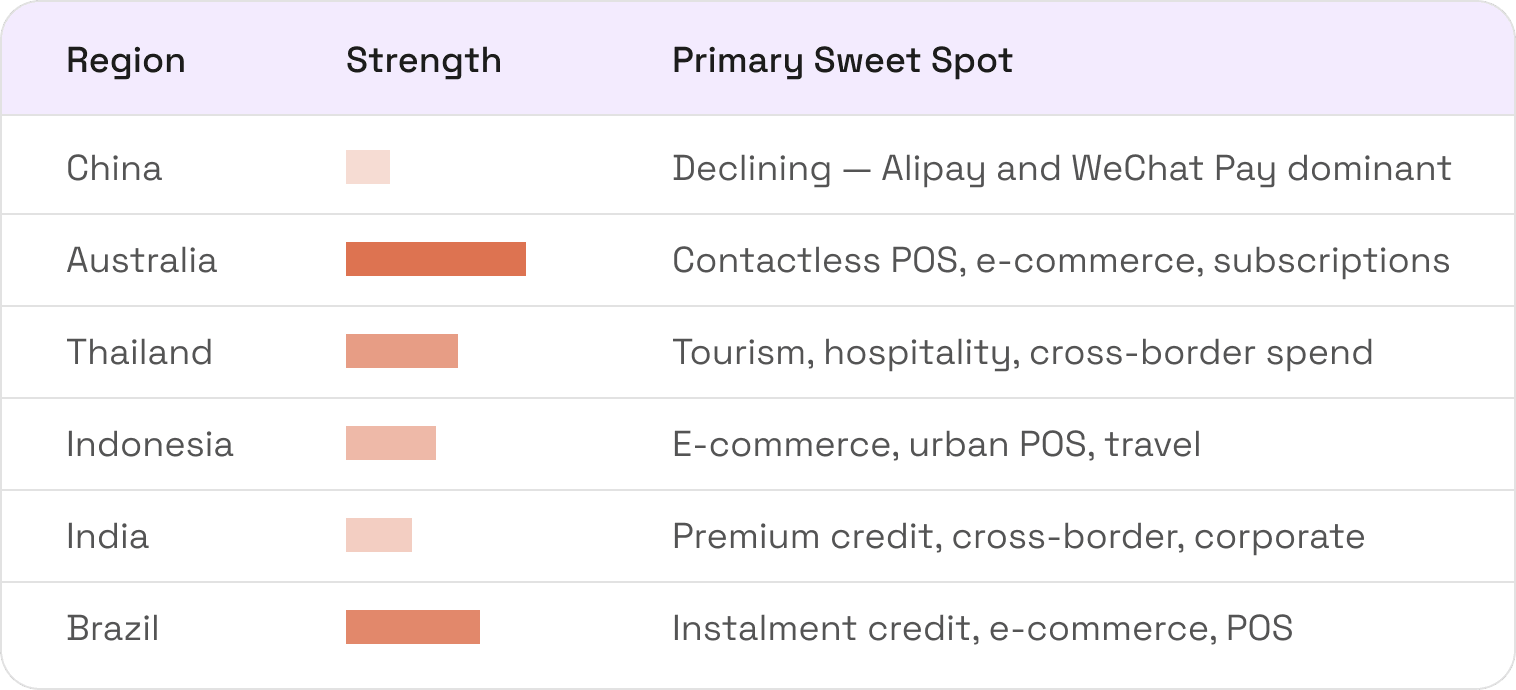
China is perhaps the closest example of mobile payments displacing cards from everyday customer behaviour. Alipay and WeChat Pay used QR codes to reach consumers and small merchants without requiring the country to build a card-terminal network on the scale seen in the US, Europe or Australia. By the end of 2023, China’s mobile-payment penetration rate had reportedly reached 86%. Alipay and WeChat Pay are not simply equivalents of open instant-payment schemes such as UPI and Pix. They are powerful private front-end ecosystems combining QR acceptance, wallets, stored value, bank-account funding and a wide range of adjacent digital services. International travellers accustomed to paying directly with Visa, Mastercard or cash often found that smaller Chinese merchants primarily accepted these domestic mobile wallets. This has produced an interesting reversal. International cards are now being embedded into these wallets to access China’s QR acceptance network.
Australia is a particularly strong example of cards adapting to the mobile era. In 2022, cards accounted for three-quarters of consumer payments—three times their share in 2007—and 97% of retail merchants accepted them. Crucially, 95% of in-person card payments were contactless, with mobile devices accounting for nearly one-third of them. Mobile adoption has therefore reinforced card usage rather than displaced it.
Thailand’s PromptPay has become deeply embedded in everyday transfers and QR payments, averaging 71.2 million transactions a day in November 2024. Yet card payments continued to grow: online card volumes increased by 14.1% and card payments through terminals by 8.3% year-on-year that month. This is another example of instant payments taking a large share of everyday transactions without eliminating cards from online, travel and credit-oriented use cases.
Indonesia is seeing similarly rapid growth in QRIS and BI-FAST. QRIS had already crossed 50 million users by August 2024, driven substantially by small merchants and MSMEs. Cards nevertheless retain important positions in e-commerce, travel, higher-income segments, credit and instalment purchases. Indonesia therefore looks less like a wholesale shift from cards to QR and more like a segmentation of use cases between the two.
India represents the strongest movement towards account-to-account payments. UPI accounted for 85% of payment volume in the first half of 2025, although only 9% of value. Debit-card payment volumes fell from 4.953 billion transactions in 2019 to 1.738 billion in 2024. Credit-card transactions, however, continued to grow—suggesting that instant payments may displace debit-card usage without necessarily replacing the credit proposition.
Brazil presents a similar picture of coexistence. Pix has become an everyday instrument for transfers and merchant payments, while cards remain relevant, particularly for credit and instalment purchases. Brazil’s central bank described Pix and cards as the country’s most-used payment instruments in 2024.
These markets are not following a single path. Australia shows how contactless and mobile technology can strengthen an already dominant card ecosystem. Thailand and Indonesia show QR and instant payments growing alongside cards, with each instrument finding its own use cases. India demonstrates how far account-to-account payments can reshape everyday spending, while still leaving room for credit cards.
The broader lesson is that payment instruments tend to be displaced by use case rather than disappearing altogether. Pricing, regulation, merchant economics, access to credit and existing acceptance infrastructure determine which rail wins in which situation.
Merchant acceptance – A key driver
- The continued strength of cards also reflects decades of investment in merchant terminalisation. Once merchants have terminals, acquiring relationships and established settlement processes, accepting cards becomes part of business as usual. Consumers, in turn, keep using cards because they can expect them to work almost everywhere. This creates a reinforcing cycle between issuance, acceptance and usage. Australia demonstrates this advantage: 97% of retail merchants accepted card payments. Widespread contactless terminals made cards convenient even for very small purchases, helping them replace cash rather than be displaced by mobile payments.
- The equation changes where terminal penetration is lower or acquiring costs are difficult for small merchants to absorb. A printed QR code requires no dedicated terminal, power supply or complex installation. This has allowed instant-payment schemes to reach roadside vendors, small retailers and informal businesses much faster than conventional card acceptance could.
- India illustrates the difference in scale. By June 2025, the country had approximately 11.8 million point-of-sale terminals, compared with around 678 million registered UPI QR codes. The measures are not directly comparable—one merchant may display multiple QR codes—but the contrast shows how much more easily QR acceptance can be distributed.
- Thailand, Indonesia and the Philippines show similar dynamics, with QR acceptance helping banks and wallets reach merchants that may never have justified a traditional terminal.
A multi-rail future for banks
Banks have had to deal with proliferating payment modes for some time now and this calls for technology that separates the customer’s payment intent from the underlying rail. Routing decisions should be able to consider cost, availability, speed, risk, transaction type and customer preference. Card and instant-payment switches may remain distinct, but should increasingly share fraud intelligence, customer controls, monitoring and operational data.
The future is unlikely to produce any single winning instrument. The better-prepared banks will be those that can introduce, operate and intelligently orchestrate multiple payment rails—without making the underlying complexity visible to the customer. Modern payment infrastructure that can span different payment modes while driving consistency of internal processes are what will make a difference between successful ones and those who struggle to keep pace.
 PREVIOUS
