

In-house Fintech: The Future of Banking?
For decades, banks have wrestled with a deceptively simple question: how much technology capability should a bank own itself?
The answer has changed several times. It may be changing again.
Outsourcing solved a real problem
A generation ago, a newly established bank could build its capabilities progressively. Start with core deposits. Add lending. Add payments. Add channels and services as the market developed. That luxury largely disappeared.
By the time a new bank came to market in the last decade, customers already expected a mature institution from day one, broad product suite, multiple payment capabilities, physical and digital channels, sophisticated security and near-continuous availability.
Extensive outsourcing became a rational answer. The benefits were significant: banks could acquire mature platforms, people, processes and operational capability far more quickly than building internally. In many circumstances, that remains entirely valid. But the long-term consequences also became clearer.
Capability is not the same as control
The limitations of outsourcing rarely appear at the beginning. Initially, the model works well. Capability arrives quickly. Technology operates. Costs appear predictable.
The challenge emerges later, when the bank needs to change.
A new market opportunity appears. A competitor introduces a new proposition. A payment rail changes. A pricing model needs to evolve. The bank wants to integrate a new partner.
At that point, the question is no longer whether the technology works. It becomes: how quickly can the bank change what the technology does? That is where capability and control begin to separate.
A technology provider quite reasonably manages against its own economics, people, infrastructure, service commitments and contracted outcomes. Those economics are not always directly linked to whether a particular change improves the bank’s business outcome. Over time, a bank can discover that it has outsourced more than technology execution. It may also have outsourced part of its ability to respond to the market.
Fintech changed the expectations
Then came fintech.
Fintech companies demonstrated that financial services could be designed very differently. Customer journeys could become dramatically simpler. New products could be introduced rapidly. Platforms could scale aggressively. And established assumptions around customer experience and delivery cycles could be challenged.
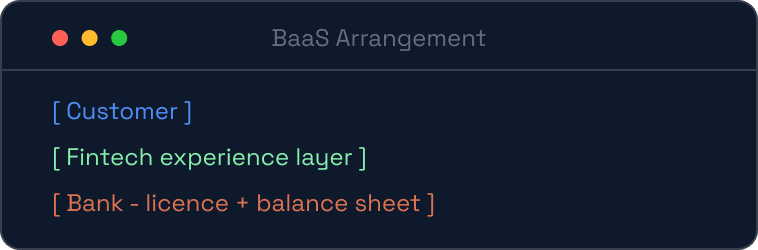
Banks responded, quite logically, by partnering with fintechs. But this introduced another strategic question: where does the customer relationship actually sit? In many models, the bank provides the regulated banking capability underneath the proposition, while another organisation controls the experience above it. That is not necessarily a bad outcome, a fintech or digital platform may reach a customer population the bank could never acquire economically on its own.
The more important question is whether the bank remains valuable beyond the licence and the balance sheet. If the platform owns the customer, the experience and the distribution, the bank should ask what differentiated capability it brings to the relationship. Can it provide products that are difficult to replicate? Can it expose richer product-lifecycle capabilities, onboarding, pricing, limits, payments, collections, risk — that the platform can consume? Can it make itself easier to integrate with, faster to change, and more capable as the relationship grows?
The objective is not to remove the fintech from the customer relationship. It is to avoid a situation where the bank becomes interchangeable infrastructure underneath it.
The strongest partnerships are those where dependence runs both ways: the bank benefits from the platform’s reach, while the platform increasingly depends on the bank’s product capability, infrastructure and domain depth.
The in-house fintech
We do not mean creating another internal IT department. Nor do we mean placing a group of people in a separate office and calling them a fintech. The idea is about capability.
A bank should be able to access many of the characteristics that make strong fintechs effective: product-led thinking, relentless simplification of customer journeys, high levels of straight-through processing, short change cycles, architecture built for scale, and accountability for delivering an outcome rather than merely completing a project.
But that capability needs one critical addition: an understanding of what it takes to make change work inside a real bank. That distinction matters enormously. And it leads directly to a stronger model for fintech partnerships. A bank may quite deliberately choose to distribute its products through fintechs, marketplaces or other digital platforms rather than acquire every customer directly. In that model, becoming more capable internally does not mean competing with the partner. It means becoming a better and more valuable one.
The bank builds deeper capabilities across the product lifecycle and exposes them cleanly for its ecosystem partners to consume. The fintech brings reach, customer engagement and distribution. The bank brings increasingly differentiated products, infrastructure, risk capability and lifecycle services.
The goal: you are as important to the fintech as the fintech is to you. That is a much stronger foundation for partnership than relying on the banking licence alone.
The functionality is often the easy part
Creating a new payment capability or customer journey can happen surprisingly quickly. The real test begins when it has to operate within an existing institution.
Will it scale to thousands of transactions per second? Has concurrency been considered? Does the architecture reflect how customers will actually behave? Has security been designed in from the start, or is it something to be remediated after testing? Can it coexist with existing core, payment, risk and channel systems?
These are not secondary technology questions. They determine whether a new capability actually becomes part of the bank.
This is where domain experience changes the outcome. The goal is not simply to develop faster. It is to anticipate the problems that otherwise emerge between “the functionality works” and “the bank can safely operate this at scale.” From our delivery experience, this approach can improve first-time-right outcomes by around 40% and reduce overall time to market by approximately 50%, not by writing software faster, but by avoiding the rework and remediation that appear when banking realities are considered too late.
Scale is where architecture tells the truth
One production environment we know well illustrates this clearly.
The earlier architecture was processing approximately 2.5 million financial transactions per day and experiencing outages, transaction errors and associated monetary losses. The modernised environment now processes close to 15 million transactions per day; around six times the previous volume, without recurrence of that class of errors. But volume is not the most interesting measure. On a like-for-like basis, operating cost reduced by approximately 66%.
Some of that comes from scale. But a significant part comes from eliminating something less visible: the continuing cost of failure. Investigation. Recovery. Operational intervention. Remediation. Financial adjustments. Customer complaints. Engineering effort spent fixing issues rather than building the next capability. The economics of sound architecture are often underestimated because many of its benefits appear as work that no longer needs to happen.
Own, control or consume
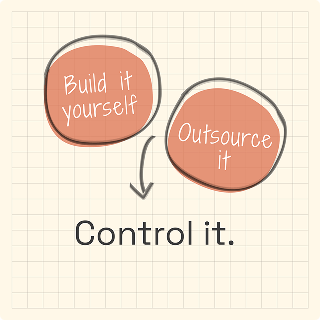
This leads to a more useful question than the traditional build-versus-buy debate.
What must the bank own? What must it control? And what can it simply consume?
A bank does not need to build every technology component itself. But capabilities that materially influence customer experience, economics, product differentiation or speed to market may need to remain within the bank’s strategic control. Control does not necessarily mean owning every line of code. It means retaining the ability to determine the roadmap, change when the market changes, govern customer experience, protect strategic data, choose or replace technology components, and avoid becoming permanently dependent on someone else’s priorities.
That is a different proposition from either traditional outsourcing or simply partnering with a fintech.
Fintech speed. Bank control.
Banks possess formidable advantages: trust, customers, licences, capital, distribution, data, deep domain expertise, and infrastructure capable of supporting financial activity at enormous scale.
Fintechs have demonstrated another set: speed, simplicity, focus, product thinking, and a willingness to challenge accepted ways of doing things. The strategic question is not which model should replace the other. It is how a bank can gain the advantages of a fintech without surrendering the advantages of being a bank. That is the capability Karplexus exists to deliver.
Not another department. Not another outsourcing relationship. Not another intermediary between the bank and its customer. A capability that brings fintech-style thinking and execution into the bank’s environment, while understanding what it takes to operate securely, resiliently and economically at bank scale.
Banks don’t need to become fintechs. They need fintech capability they can control.
 PREVIOUS
NEXT
