


From Accepting Payments to Understanding Cash Flow: The Business Behind Every Payment
Account-to-account payments are expanding rapidly across markets. That naturally creates an interesting question for banks: does A2A create a new acquiring opportunity?
We think it does. But perhaps not in the most obvious way.
The opportunity may be much bigger than processing another form of payment. It may be a chance for banks to build a fundamentally deeper relationship with businesses they have historically served primarily through accounts and transactions. That distinction matters more than it might initially appear.
The merchant relationship banks already had
Banks have always served enormous numbers of businesses. They hold operating accounts, receive collections, move money, and may provide credit, deposits, foreign exchange and other financial products.
Yet the merchant acceptance relationship often sits elsewhere.
Payment gateways, aggregators, acquiring specialists and more recently software platforms have built sophisticated merchant propositions around onboarding, acceptance, settlement and customer experience. There were good reasons for this. For many banks, particularly with smaller merchants, direct distribution was difficult. The individual merchant opportunity appeared relatively small. Onboarding and monitoring were operationally intensive. And there were often more attractive places to deploy technology investment and organisational attention.
The intermediaries solved a genuine problem. They aggregated demand, built distribution, simplified onboarding and created viable operating models around a highly fragmented merchant market.
That ecosystem will not disappear simply because A2A payments are growing.
A2A does not eliminate the aggregator
This is important to state clearly.
The merchant does not care which payment rail wins an industry debate. Its customers may want cards, account payments, wallets, credit, rewards or whatever method is most convenient at that moment. The merchant itself cares about conversion, certainty of payment, settlement, reconciliation, refunds and the overall economics.
An aggregator capable of abstracting that complexity remains valuable.
Which means the bank should not approach A2A by asking: how do we replace the payment gateway? Nor should it assume that lower payment cost alone will determine behaviour. Consumers respond to convenience, familiarity, credit and rewards. Merchants respond to conversion, settlement certainty, operational simplicity and total economics.
The rail matters. The proposition around the rail often matters more.
What actually changes for the bank
A2A creates a different opportunity — not an obvious one, but a more durable one.
As more payment activity originates directly from bank accounts, the volume of merchant-related account flows becomes increasingly significant. Businesses that may have appeared relatively uninteresting individually become meaningful when viewed as a large, digitally accessible segment.
But the opportunity for the bank is not simply: we can process these payments ourselves.
It is: what more can we do because we sit at the centre of the merchant’s financial life?
That is a fundamentally different question.
From accepting payments to understanding cash flow
Consider what happens if the bank treats the payment not merely as a transaction, but as part of a business process.
Money arrives. But alongside the money, there can be information: which customer paid, against which order, against which invoice, whether it was a full or partial payment, what remains outstanding, when settlement is expected, what this does to today’s liquidity position, and what the business might need to fund next week.
The richness of that information will vary by payment rail, market and integration model. But the opportunity is increasingly to connect fund flow with information flow.
That is where merchant banking becomes genuinely interesting.
The bank moves from being the institution that receives money to being the institution that helps the merchant understand and manage how money moves through the business. That is not a marginal improvement to the existing relationship. It is a fundamentally different one.
Enter the CFO stack
This suggests a different strategic endpoint altogether.
Rather than concentrating only on the checkout, banks can connect themselves more deeply into the merchant’s operating environment — accounts receivable, accounts payable, reconciliation, collections, cash positioning, liquidity management, working capital, treasury, ERP and accounting systems, vertical business software.
The bank does not necessarily need the merchant to log into another banking portal to consume all of this. Increasingly, the more powerful model is for banking capabilities to appear inside the systems in which the business is already operating. APIs into an accounting platform. Collections embedded into invoicing. Settlement information feeding directly into reconciliation. Working-capital options appearing within the workflow when the business actually needs them.
The payment becomes the beginning of the relationship rather than its end.
The economics become more interesting too
Payment economics are rarely static. Fees change. Regulation changes. Competitive pressure changes. Different payment instruments have different commercial models. Trying to build an enduring merchant strategy around the economics of one payment rail is therefore risky.
The more durable question is: what are the economics of the total merchant relationship?
A bank may derive value from operating balances, payment and collection activity, settlement, lending, working-capital products, treasury services, foreign exchange, cash-management services and the broader lifetime value of the business relationship. That is a very different proposition from competing for a few basis points on payment acceptance.
A useful test: if the merchant business case disappears when the payment fee changes, was there really a merchant business model to begin with?
Payments can also improve the credit conversation
This is where the relationship becomes particularly powerful.
Traditional business lending depends heavily on periodic financial information, formal documentation and, in some products and markets, hard collateral. But a bank with deeper visibility into actual business cash flows has another important source of information.
How stable are collections? How concentrated are customers? How seasonal is the business? Are receivables slowing? Is turnover growing? How volatile are daily cash flows?
These signals cannot replace proper underwriting, risk policy or regulatory requirements. But they can enrich the credit decision. They may also make it possible to design working-capital propositions more closely aligned with how the business actually operates — something a pure payment processor cannot necessarily provide on its own.
This is why the bank’s role can become more valuable, not less, as payments become more embedded.
The bank does not have to choose
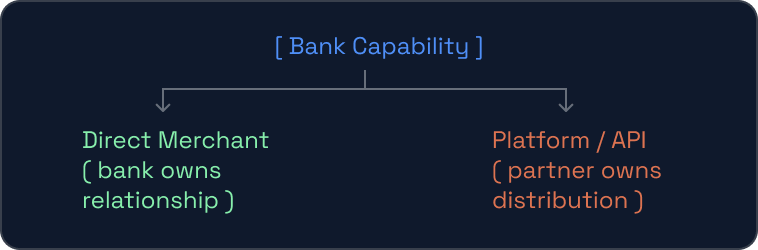
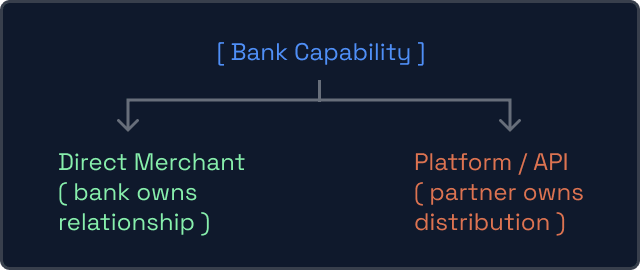
A bank pursuing this opportunity does not have to decide between acquiring merchants directly or working through aggregators. It can do both.
A sufficiently capable bank can provide a direct proposition to merchants that value a closer banking relationship — while simultaneously exposing the same underlying capabilities through APIs to payment aggregators, gateways, fintechs, marketplaces, accounting platforms, vertical software providers and other ecosystem partners.
Two distribution models. One institutional capability.
Direct-to-merchant: the bank controls more of the relationship and connects payments closely with other banking products. Platform-enabled: the partner owns distribution and much of the customer experience, while consuming banking capabilities the bank provides.
Neither model is inherently superior. The strategic objective is to ensure that the bank contributes something more valuable than simply its licence and balance sheet — and becomes genuinely difficult to replace.
The real barrier is not the payment API
Building the interface to accept an A2A payment is not the entire acquiring proposition.
Real merchant businesses require onboarding, risk controls, pricing, partner economics, settlement, reconciliation, refunds and disputes, monitoring, reporting, operational support and the ability to function continuously at scale. These capabilities quickly become more important than the payment initiation itself.
One consequence is strategic: the bank does not have to force all of this into the traditional core banking system. A modern merchant platform can manage high-volume merchant activity, lifecycle processes and ecosystem interactions outside the core, while the core retains the authoritative financial records. That separation materially improves scalability and change velocity — and makes it easier to serve both merchants and intermediaries through the same underlying platform.
The future of acquiring may be rail-agnostic
Historically, acquiring was closely associated with the payment instrument — card acquiring, account transfers, wallet acceptance, alternative payment methods. But merchants increasingly need a coherent proposition across all of them.
The winning model may be less about choosing the rail and more about creating an architecture in which rails can come and go while the merchant relationship remains intact.
The merchant sees one relationship, one operating experience, one view of money, one reconciliation framework, one set of financial services. Underneath that experience, multiple payment mechanisms coexist.
In that world, A2A is highly significant — not because it necessarily replaces what came before, but because it expands the account-based payment pool enough to make a new kind of merchant-banking proposition economically and strategically worthwhile.
Beyond moving money
The most interesting question around A2A is not whether it will replace cards. Nor even whether banks will become acquirers again.
The deeper question is: as payments become increasingly embedded and payment rails become easier to access, where will the durable value sit?
Simply moving money will always matter. But moving money may increasingly become the entry point. The more valuable capability is understanding the context around that money — the business, the invoice, the receivable, the cash-flow position, the working-capital requirement, the risk, and the financial needs that come next.
That is an opportunity banks are particularly well positioned to address. And it is precisely the kind of capability that Karplexus exists to help them build.
A2A may open the door. The real opportunity is what the bank builds on the other side.
 PREVIOUS
NEXT
