A payment platform that takes the load off your core and gets money moving right, every time.
500+
TPS design
target
ACID • no floating point
1000+
TPS with
shadow-pool
same core
data model
0
Divergent
code paths
OpenShift •
EKS • AKS
2x
Dedup
layers
in-memory +
durable
Problems we like solving
The questions that earned our attention.
Each one has bitten someone in production. Technology appears once the problem has earned it.
core offloading
How much payment complexity can you take off a core banking or treasury system before it stops needing to be a payments engine at all?
dual-clock design
How do you build one ledger equally at home settling a payment in under a second and running tonight’s batched settlement?
shadow-pool pattern
How do you keep a ledger correct when thousands of transactions want the same account at once, without giving up ACID guarantees?
// How we think about engineering
One theme per cluster.
A way of thinking about the problems, five clusters, each with a distinct character.
what we build
A ledger core built for any rail. Instant, batched, and stored-value on one ledger. ACID guarantees. No floating-point arithmetic near a balance. Template-driven behaviour so adapters diverge, the core doesn’t.
getting it right
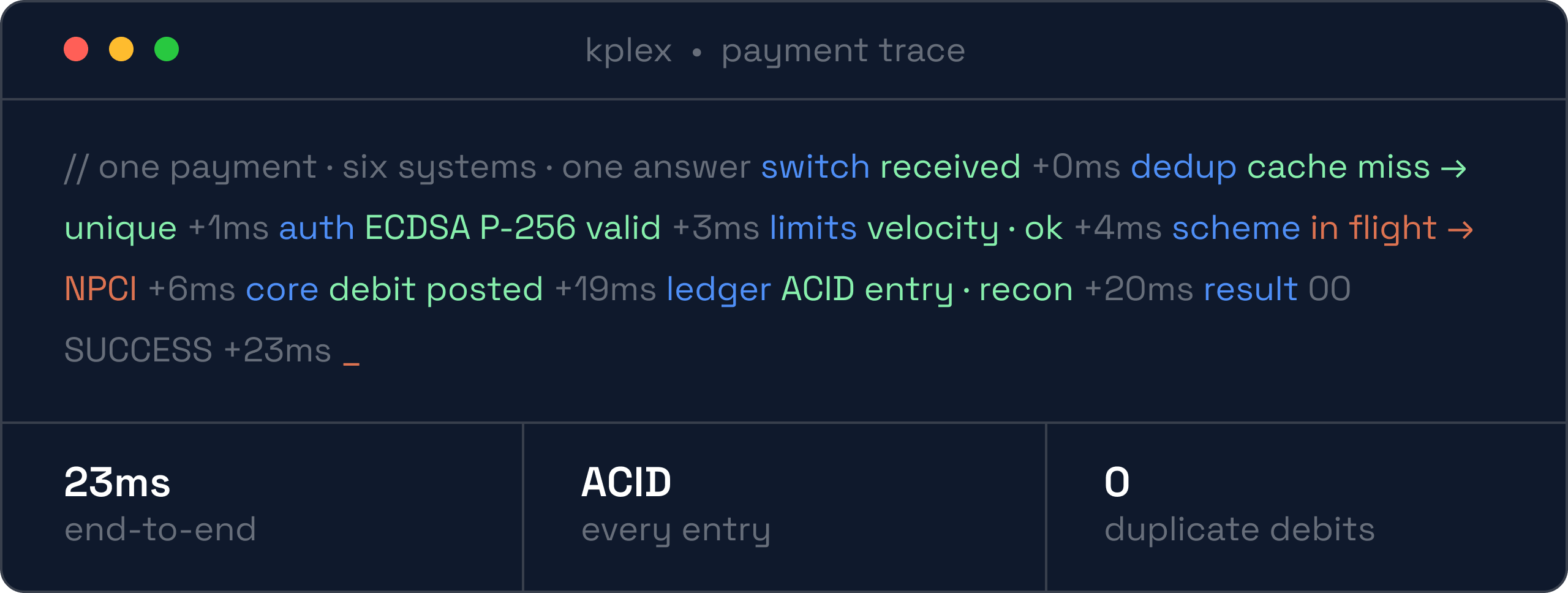
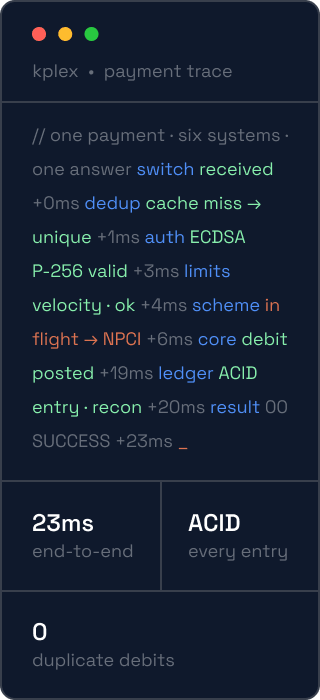
One confident answer when six systems disagree. Convergent state machines. Two-layer deduplication. Shadow-pool redesign that lifts hot-account throughput from ~200 to 1000+ TPS. Reconciliation as part of the platform’s rhythm, not an ops chore.
trust
Cryptography as production infrastructure. ECDSA P-256 for signed-QR and intent flows. Envelope encryption with version-embedded keys, rotation mid-transaction doesn’t break verifiability. Audit logs encrypted before they reach storage.
many markets
One core, many rulebooks. Message formats, signing rules, and settlement windows change per market. The invariant part of the protocol, ledger, state machine, dedup — never does. New market means a new adapter, not a new codebase.
running it well
One signal, any backend Structured JSON to stdout. Node-level OpenTelemetry DaemonSets. The telemetry destination is a config choice, not a rewrite. Same containers on OpenShift, EKS, and AKS, no divergent code paths.
skills landscape
GO • RUST • gRPC
Banking-grade Scrutiny.
Go for service architecture and protobuf/gRPC APIs. Rust for performance-critical routing. Product engineering that holds up under banking-grade scrutiny.
upi • imps • Rtgs
Batched and
Real-time.
Multi-rail adapters across real-time and batched flows. Acceptance and issuance. QR and EMVCo signing. Inter-institution messaging with scheme-level semantics.
Platform-independent deployment across OpenShift, EKS, and AKS from a single build. Per-customer CD pipelines. Service-mesh failure modes. OpenTelemetry-based observability.
ledger design • rail mechanics
Precision meets
Design.
Ledger design and financial precision. Real-time and batched payment mechanics. Velocity and limits design. Wallet and stored-value semantics. Reconciliation.
// Who thrives here
Not a culture deck.
A description of the thinking the work actually requires. People who’d rather design one ledger primitive than three narrower systems, and who ask what a core system shouldn’t have to do.
You'd rather trace a bug across five services than fix a symptom in one.
“What happens if this arrives twice?" interests you more than “does this work?"
You separate “what's invariant" from “what's market-specific" before writing adapter code — for a rail, a cloud, or a telemetry backend.
When the platform does something unexpected, you read its internals rather than working around it.
You think about what breaks at 10x volume — and at the tenth new country — before anyone asks.
You're comfortable owning code that runs inside someone else's infrastructure, on someone else's terms.
Tell us where the pipeline breaks. We'll tell you what it takes.
We’ve been inside the systems you’re running. We know what they cost — and what it takes to move past them, incrementally, without the big-bang risk.